
| Decision | What to read | Planning use |
|---|---|---|
| Distance band | Short is under 21 km, medium 21-42 km, long 42-80 km, ultra over 80 km | Fix the band first. Ascent then decides whether that band is realistic. |
| Difficulty label | Beginner, Intermediate, Advanced or Elite | Treat the label as an opinion to test against the ascent figure, not a verdict. |
| Ascent | Listed as D+; one regional calendar spans 300-5,500 D+ | Compare D+ with distance. The same distance can carry very different climbing. |
| Cut-offs and aid stations | Safety management is a core topic for trail race organisers | Read the regulations before registering and confirm the pace the cut-offs demand. |
Band and label conventions come from the Trail Run Temple race calendar, and the safety point from a Race Directors HQ podcast episode on running trail races.
How to choose a Cevennes trail race comes down to distance band, ascent, terrain and cut-offs. Pick the shortest format that passes all four checks, and use any difficulty label only as a starting point.
The steps below follow the order in which decisions usually fall, from shortlisting to the final fit check. Races listed under cevennes trail races can all be run through the same sequence.
Shortlist by distance band
Distance is the coarsest filter, so apply it first. The Trail Run Temple calendar groups races into short (under 21 km), medium (21-42 km), long (42-80 km) and ultra (over 80 km) bands, and that grouping is a practical way to sort a long list quickly.
- Pick one band. Choose the band that matches the longest distance you can already cover comfortably, not the one you hope to reach.
- Look for multi-format events. Many organisers run several distances on one weekend, so a short option may sit beside a headline ultra.
- Match the date to your build-up. Calendar listings show a date for each race. Check it against your training and the usual conditions described on the organiser’s page.
Graded formats for a first race
The Trail du Confolentais in Confolens is not a Cevennes race, but its programme shows what a graded ladder looks like. Its formats run 2, 7, 9, 12, 20 and 30 km, and the Finishers event page describes the shortest as a way to “treat yourself without freaking yourself out” and the 7-9 km options as a first exploration. For a first trail race, an event with a very short format is a safer entry than a long race with a token short option.
Read the ascent
Elevation gain is the second filter, because it changes what a distance means. Organisers usually print it as D+, the cumulative climb over the course. The Île-de-France section of the calendar lists distances of 10-120 km and an elevation range of 300-5,500 D+, so ascent varies enormously across a single regional calendar.
A range is not a recommendation, and no calendar sets a safe ascent for beginners. The practical rule is to stay near the lower end of whatever range the organiser lists for your chosen distance. Check that figure against the climbing you have already handled in training before entering.
How distance, ascent and terrain combine
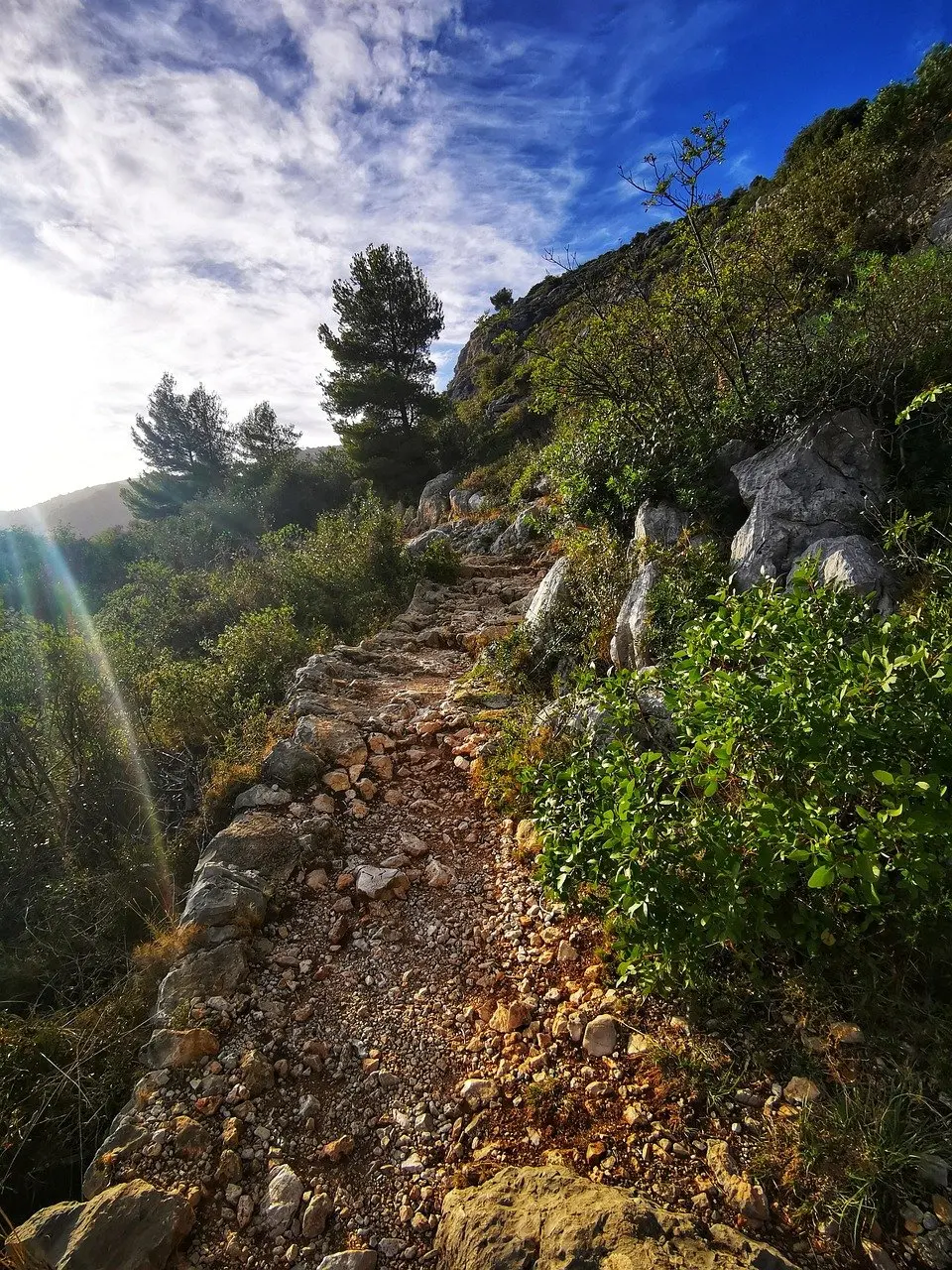
Difficulty is the combination, not any single figure. A medium-band race with heavy D+ can demand more than a long-band race on gentle ground. Read distance and D+ together, then ask what the ground is like. Rocky, steep or remote sections slow everyone down, and a slower pace is what pushes a runner towards the cut-offs.
Compare labels and ratings
Difficulty labels are useful for sorting, but they are not a shared standard. The calendar uses four levels: Beginner, Intermediate, Advanced and Elite. Other organisers and calendars may use different scales or none at all, so a label from one source cannot be carried over to another.
| Event | Label | Distance options | Reading |
|---|---|---|---|
| Les 40 Bosses (5 Dec 2026) | Advanced | 120K, 75K, 45K, 20K | One label spans the whole 20K to 120K spread, so it says little about the shortest option. |
| EcoTrail Paris Rambouillet (20 Mar 2027) | Intermediate | 120K, 80K, 45K, 30K | The 45K appears here under Intermediate and above under Advanced, so event labels do not line up. |
Both listings, which are Île-de-France examples rather than Cevennes races, come from the Trail Run Temple calendar.
The rule that follows is to rank races by the distance and D+ you can verify, and use the label only to break ties. A Beginner label with a large D+ figure still deserves a second look.
Check cut-offs and aid stations
Cut-off times decide whether a race that looks achievable on paper is achievable on the day. Race directors list managing risk and keeping participants safe as a core trail race topic, per the Race Directors HQ podcast, and cut-offs and aid points are part of that system. Read the regulations for each checkpoint and compare the demanded pace with the pace you would hold on the steepest climbs, not on flat ground.
What to look for in the regulations
- Cut-off placement. Note whether the first time limit falls before or after the main climb. An early limit on a hard section leaves the least margin.
- Aid station contents. The same podcast names finding and attracting volunteers as a challenge for trail races. Read what each station actually offers and avoid assuming more support than the regulations list.
- Gaps between stations. Longer gaps on steep or remote ground call for a more careful plan for your own supplies.
When a race passes these checks, the next job is registration. The guide on how to enter a trail race in france covers that step.

Run the final fit check
The last step is a personal fit check that combines everything above. Work through these actions in order and stop at the first one that fails.
- Confirm the band. The distance sits in a band you can already cover.
- Confirm the ascent. The D+ is at the low end of the organiser’s range for that distance and close to climbing you have done.
- Confirm the terrain. The surface and exposure suit your footing and pace.
- Confirm the cut-offs. You can meet every time limit at climbing pace with a margin.
- Confirm the date. The race falls in a window you can train for.
If one check fails, step down a format at the same event or move to a gentler race. Trail racing is described as growing at a healthy rate while other racing segments stagnate, so a spare option on the shortlist costs little. The best trail races in the cevennes list is a good place to find alternatives.

Frequently asked questions
How do I know if a Cevennes trail race is too hard for me?
It is too hard if any one of the distance, D+, terrain or cut-off checks fails. A single failure matters more than a good average, because a time limit on a steep section can end a race regardless of fitness elsewhere.
How much elevation gain is reasonable for a first trail race?
The calendar data gives a range of 300-5,500 D+ across one region but no beginner threshold. Choose the low end of the range for your distance and compare it with your recent training climbs.
Is a Beginner label the same at every race?
No. Labels are set by each organiser or calendar. The same 45K distance appears under both Advanced and Intermediate events, so compare D+ and cut-offs instead.
Which distance suits a first trail race?
A short format under 21 km is the usual entry point, and graded events such as the Trail du Confolentais offer 2 km and 7-9 km formats for newcomers.