
Trail running training works best when it builds an easy aerobic base, adds one longer run each week, and treats climbing and descending as separate skills. The first decision is your race profile: steep and rocky, or long and rolling.
Most runners can start with the broad structure below and then go deeper into the guide that matches their race. For a race-specific build, how to train for a hilly trail race covers the hill-heavy end of the sport in more depth.
Choosing where to start
Three questions decide where a trail runner should begin: how far the race is, how much climbing it contains, and what terrain is available for training. The answers point to different first steps, and none of them requires a mountain on the doorstep.
- Race distance sets the plan shape. A runner aiming at a shorter race can follow a trail half marathon training plan. Longer ambitions are covered by a trail marathon training plan and a 50k trail training plan. Each lengthens the weekly long run and the time spent on feet, so the base work in this guide comes first in all of them.
- Steep climbs call for hill work early. If the course climbs hard and descends on loose, rocky ground, hill sessions and descent practice should appear in the first weeks rather than the last ones.
- Little climbing means the base matters most. A rolling course rewards easy aerobic running, a reliable weekly long run and sound fuelling before it rewards specialised hill intervals.
- No hills nearby means improvising. Runners in flat regions need to alternate routes and use other tools to simulate climbing, as covered further down.
- Injury history changes the order. A runner returning from a niggle should start with stability work and gradual load before adding any steep running.
Whatever the answer, the sequence is the same: build easy volume, add specific work gradually, and test every piece of kit before race day. The next section sets up the easy running that everything else rests on.
Easy running and heart rate zones
Easy running is the foundation of trail training. Sport Conrad’s trail competition plan describes easy runs at a comfortable pace, or in heart rate zone 2, as the base that other sessions build on, and suggests training at around 60-70% of maximum heart rate for this work.
Why effort beats pace on trails
On a steep, rocky course, pace swings with every gradient, surface change and technical section. The same source notes that heart rate, perceived effort and elevation gain are often more meaningful than speed alone in trail running. For a runner preparing for southern French hill terrain, that is a practical reason to judge easy days by effort. A watch showing a slow pace on a climb does not mean the session went badly.
Putting heart rate to work
Heart rate zones help most on easy days, when the temptation is to run faster than planned. A runner who keeps those days in the easy band protects the energy needed for hill sessions and the long run. For zone setting, drift and how to read the numbers on climbs, see heart rate training for trail running.
Easy running also gives time to practise the skills that cost nothing: footwork on uneven ground, relaxed shoulders and steady breathing. The weekly long run then stretches this base in time, which is the next piece.
The weekly long run
Trail racers should include one longer run once a week, according to Sport Conrad’s training guidance, which presents it as the session that builds the aerobic base. For most runners this is the answer to how often long runs should appear: weekly, with the rest of the week arranged around it.
Where the long run fits
Because the long run is the biggest single load of the week, it deserves protection. Place it after an easy day rather than after a hard hill session, and follow it with easy running or rest. Hill repeats and the long run on consecutive days are a poor pairing for most runners, because the second session is then done tired and on unsteady legs.

Choosing the terrain
Long runs are the best place to rehearse race conditions, because they combine duration, terrain and fuelling in one session. A runner preparing for a steep, rocky race benefits from taking at least some long runs onto surfaces that resemble it, since that is where footwork and kit problems show up. Weeks with a flatter long run are still useful, as the plan can alternate flatter and hillier routes, a point developed in the elevation section below.

The long run is also when fuel and fluids get tested, which is covered with the gear in a later section. Next come the sessions that target climbing directly.
Hill sessions for a hilly race
Hill repeats and hill intervals are the most direct way to build climbing strength and intensity. Sport Conrad lists interval training, including short sprints or hill intervals, as the tool for building intensity, while the beginner plan in Trail Run Initiation gives a concrete hill session: hills at 8-10% incline, 8 x 1 min repeats, with recovery between efforts decreasing as the plan progresses.

Training for a hilly 20 km race
For a race of around 20 km with sustained climbing, the same plan culminates in a 12-20 km competition, so its hill structure is a sensible template for the distance. The approach for a hilly race of this length combines three habits:
- One structured hill session in the week. The 8 x 1 min format gives a clear, repeatable session that can be progressed without guesswork.
- Alternating terrain. The Sport Conrad guidance suggests running flatter routes at some times and hillier routes at others, which keeps the legs from adapting to a single profile.
- Gradual progression. The same source advises increasing pace and elevation gain gradually to avoid overload.
Repeats versus a full hill plan
A single hill session can sit inside any weekly routine, and hill repeats for trail running explains the format in detail. Runners who want a structured progression across several weeks will find a hill training plan for trail running more useful than ad hoc sessions.
Repeats build the engine for climbing. Technique for the climb itself, including when to stop running, is the next topic.
Uphill running, power hiking and poles
On a steep climb, the efficient choice is whichever gait keeps effort under control. Because heart rate and effort are better guides than pace on trails, a runner who sees effort climbing sharply on a steep ramp has a clear signal to shorten the stride or walk briskly. How to run uphill trail covers the running technique, and power hiking trail running covers the walking alternative that many racers use on the steepest sections.
Deciding between running and hiking
The choice depends on gradient, the length of the race and how many climbs remain. Early in a long race with a lot of climbing ahead, hiking steep ramps is a way to hold back effort. Near the end of a shorter race, a runner with energy in reserve may run more of the same slope. The practical step is to rehearse both in training, so the decision on race day is made from experience.
Trekking poles
Poles are a skill as well as a piece of kit. Sport Conrad lists poles among the equipment that should be tested under realistic conditions during training, alongside shoes, pack and flasks. A runner who plans to carry poles on a hilly course should practise folding, carrying and using them on long runs well before race day. Whether poles are permitted or useful depends on the individual race, so the organiser’s rules should be checked when planning.

Climbing is only half of a hilly course. The other half is the way down, and it does most of the damage to legs and knees.
Downhill running and protecting the knees
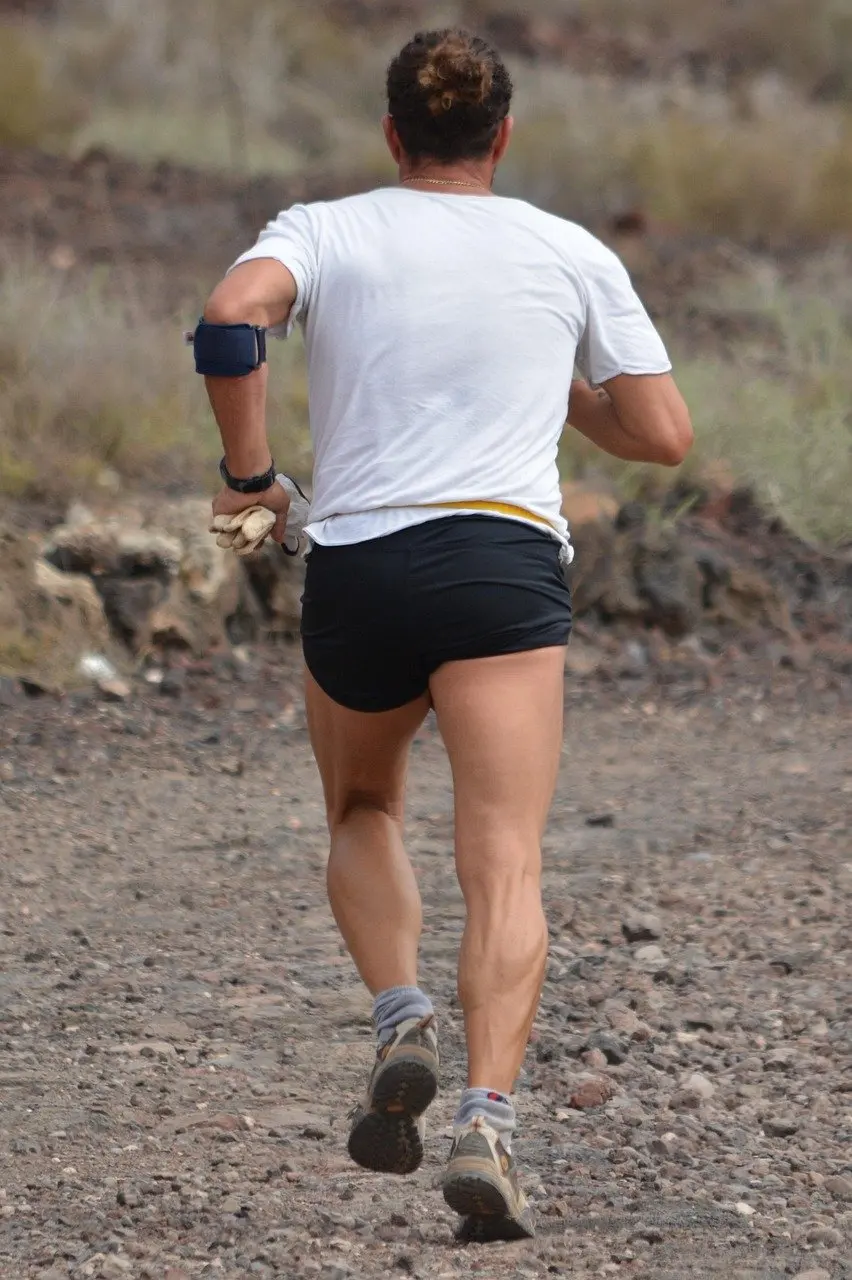
Descending is a skill that needs its own training. Trailia’s weekly structure guide describes vertical gain and descent as trained skills in their own right, and that is the clearest answer to how to run downhill without hurting the knees: practise it deliberately, and build up gradually rather than saving it for race day.
Progress from easy to technical
The beginner plan in Trail Run Initiation has runners test going down quickly on easy descents before moving to harder ground. That order makes sense for rocky terrain: smooth, forgiving slopes teach rhythm and cadence at low risk, and technical descents come only once the legs and the footwork are ready.
Strength supports the descent
Sport Conrad recommends stability work for the core, ankles and leg axis. On steep descents the legs absorb repeated landings, so a leg that stays well aligned over the foot is a sensible aim. That is why descent practice and strength work belong together in a plan, rather than as separate topics.
For technique cues and session ideas, see how to run downhill trail. The strength work that backs it up is next.
Strength and stability for trail runners
Strength training for trail runners should target the parts of the body that rough ground challenges first. Sport Conrad’s guidance is to focus stability training on the core, ankles and leg axis, and Trailia describes a library of 80+ trail-specific strength exercises with video guidance, which shows how broad the menu can become.
Start with a short list
A long menu is not a reason to do everything. The sensible approach for most runners is to choose a small group of exercises covering the three priorities, repeat them each week, and progress them gradually. The full range is set out in strength training for trail runners, and the trunk-focused side is covered by core exercises for trail runners.
Strength alongside running
Strength sessions should support running, not compete with it. Keep them away from the day before the long run, and ease them back in recovery weeks along with the rest of the load. Mobility and joint care complete the picture, and trail running injury prevention collects the habits that keep a build on track.
Strength and descent skills matter even more for runners who must simulate climbing away from the hills, which leads to the next problem.
Training for elevation gain without mountains nearby
Runners without mountains can still prepare for a climbing course by alternating route types and raising the load slowly. Sport Conrad advises running flatter routes at some times and hillier routes at others, and increasing pace and elevation gain gradually to avoid overload. Trailia treats vertical gain as its own skill, so it deserves deliberate attention even in a flat region.

Making the most of what is available
Any available slope is a training tool, and the hill repeat format works on short climbs as long as the effort is right. The runner who has only gentle gradients can keep the structure of the hill session and concentrate on consistent effort. Stability and strength sessions then supply the muscular work that the terrain cannot.
Further reading by situation
A runner with an occasional trip to hillier ground should plan the biggest climbing session for those visits and keep home weeks easier. For a full progression, how to train for elevation gain running sets out the vertical-gain build, and train for trail running on flat terrain goes into substitutes for hills.
Whatever the terrain, the final piece is the equipment and fuel that gets used on race day.
Shoes, vest and fuelling
Race kit should be chosen and rehearsed during training. Sport Conrad states that shoes, running pack, flasks, poles, gels, bars and drinks should all be tested under realistic conditions during training. For a summer race on dry, rocky ground, realistic conditions include long runs in warm weather on similar surfaces, not only comfortable cool sessions.
Shoes
Footwear choice for rocky ground is a balance of grip, protection and comfort over hours. Rather than rely on a description, the runner should wear the intended pair on the longest training runs and check for rubbing, toe pressure and how stable the shoe feels on loose stones.
Hydration vest and flasks
A hydration vest carries fluid, food and the mandatory items some races require. Fit matters more than capacity: the vest should sit still on a descent and leave the shoulders free on a climb. Soft flasks and any poles should be accessible without stopping, which only becomes clear after practising on the move.
Fluid and carbohydrate
The same Sport Conrad guidance suggests drinking around 500 ml of water per hour and starting carbohydrates after 90 minutes at the latest, at around 60 g per hour. Those are guide figures for long runs, so the practical step is to rehearse the plan on long sessions and adjust it to what the stomach tolerates. Nothing about fuel should be new on race day.
With all the parts in place, the remaining job is to arrange them into a week and a block.
Arranging the week and the build
A trail week works as a repeating pattern of easy running, one long run, one hill session and a little strength. Trailia describes a schedule in which load grows gradually and one channel at a time, with regular recovery weeks, which means the volume, the climbing and the intensity should not all increase at once.
A weekly pattern for steep, rocky courses
- Early in the week: easy running on forgiving ground, with stability work after it.
- Midweek: the structured hill session, on a slope that matches the race gradient as closely as the area allows.
- Later in the week: a short easy run or rest, so the legs are fresh for the long run.
- Weekend: the long run on terrain resembling the race, carrying the intended vest, flasks and fuel.
Adding load without overload
Change one thing at a time. A week that adds a longer long run should keep the hill session unchanged, and a week that adds climbing should leave the long run alone. Recovery weeks then absorb the training rather than interrupting it. The table pulls the main building blocks together.
| Session | Guide | Planning use |
|---|---|---|
| Easy run | Heart rate zone 2, about 60-70% of maximum heart rate | Default setting for non-key days, judged by effort rather than pace |
| Long run | Once a week | Anchor of the week; protect it from hard sessions on adjacent days |
| Hill repeats | Hills at 8-10% incline, 8 x 1 min repeats | Template for the weekly hill session; progress it gradually |
| Stability work | Core, ankles and leg axis | Short sessions alongside running, eased in recovery weeks |
| Fuel rehearsal | About 500 ml water per hour; carbohydrates from 90 minutes, about 60 g per hour | Practise on long runs so race-day fuelling is familiar |
These figures come from the Sport Conrad trail competition plan and the Trail Run Initiation plan, and they work as starting guides rather than fixed prescriptions.
Frequently asked questions
What does a beginner trail plan look like?
The beginner plan in Trail Run Initiation lasts 6 weeks, progresses in distance and difficulty each week, and reaches a 12-20 km race in week 5.
Should trekking poles be part of training?
If poles will be carried on race day, they should be tested in training like any other kit, as Sport Conrad recommends. Race rules and course profile decide whether they are worth carrying.
What recovery work helps between sessions?
Sport Conrad lists foam rolling, mobility exercises, yoga and stretching as ways to help the body relax after hard training.
Do climbing and descending need separate practice?
Yes. Trailia treats vertical gain and descent as skills trained in their own right, so a plan for a steep, rocky course should include sessions for each.